
How to Choose Countertop Edge Profiles? What You Need to Know Before Fabrication
In any countertop project, everyone talks about surface color first. The edge, on the other hand, usually comes up during templating with a single question from the fabrication shop: How would you like the edge finished? The answer you give at that moment shapes how your kitchen will look, how it will be cleaned, and how it will feel to use for years to come. Countertop edge profiles are just as visible as the surface itself, yet rarely discussed with the same care—and more often than not, they are the last decision made.
In this guide, we go beyond simply listing profile names. We walk step by step through which edge suits which usage scenario, what to pay attention to in edge fabrication details, what to verify before executing a waterfall edge (a countertop finish that extends continuously to the floor), and when to lock in your decision.
What Is a Countertop Edge Profile and Why Does It Matter as Much as Color?
A countertop edge profile is the cross-sectional shape given to the front and exposed edges of a countertop. Options such as straight, oval, rounded, or waterfall determine far more than appearance; they also dictate how a corner responds to impact, how easily it wipes clean, how comfortable it feels to the touch, and how much visual weight the countertop carries in the kitchen. In short, the edge is the part of the countertop that is touched—and bumped—the most.
Why Should the Edge Be Treated as a Separate Decision?
Once the surface slab is chosen, it often feels like the selection process is over. Yet the exact same slab can give a kitchen an entirely different character depending on its edge. A crisp, clean-lined edge makes a countertop look architectural and slim, while a softly rounded edge creates a warmer, more casual feel. Treating the edge choice as its own decision ensures the edge and surface truly complement each other.
Thinking Through the Cross-Section: Three Simple Questions
A practical way to narrow down your edge choice is to boil the decision down to three questions:
How many times a day will this edge come into contact with hands, elbows, cookware, or chairs?
Will dirt and moisture that collect along the edge wipe away easily?
Does the visual weight of the edge harmonize with the cabinet fronts and the overall design?
Answering these three questions will immediately rule out most of the options below.
Quartz Countertop Edge Models: Main Options
Although countertop edge varieties may seem endless, in practice they fall into a few core groups. Everything else is a variation derived from them.
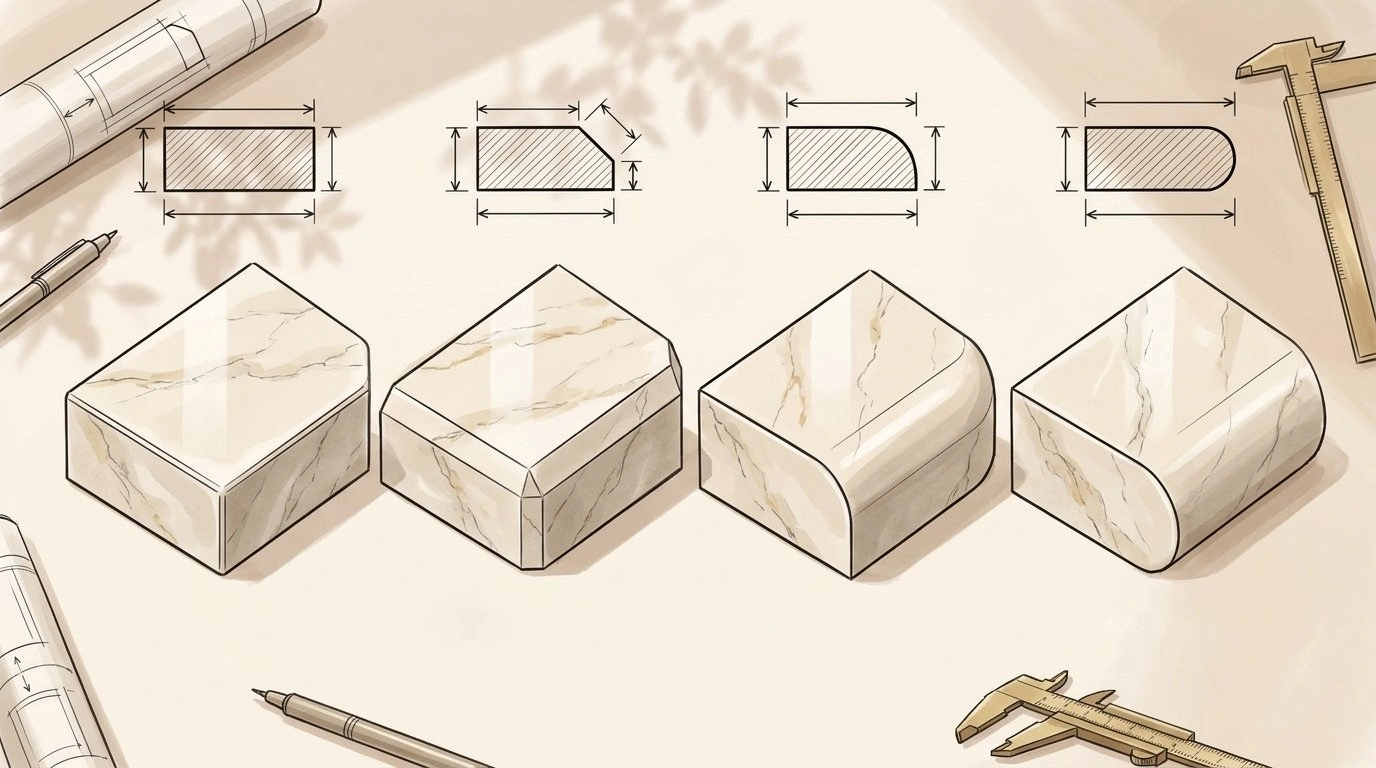
Straight and Slightly Eased (Micro-Beveled) Edge
A straight edge features a right-angled cross-section, delivering the crispest look for contemporary and minimalist kitchens. In practice, it is never left razor-sharp; the corner is eased by a few millimeters to soften it slightly. This micro-bevel reduces the risk of chipping on impact and makes the edge comfortable wherever your hand rests against it.
Rounded Edge: Quarter-Round and Bullnose (Half-Round)
A quarter-round edge softens the top corner while keeping the underside flat. With a bullnose (half-round) edge, the entire cross-section is curved. Rather than concentrating impact at a single point, rounded profiles distribute force across the surface and are effortless to wipe clean. That is why they are frequently chosen for family homes with children and heavily used island edges. In return, they lend the countertop a softer, more classic character.
Beveled and Decorative Profiles
Pronounced angled bevels and multi-stepped profiles such as ogee and dupont add shadow lines and depth to the edge. They work particularly well in classic and neoclassical kitchens. However, the more steps a profile has, the more recesses and ridges there are to clean. In high-use kitchens, it is worth factoring in the extra maintenance these details require.
Built-Up (Laminated) Edge for a Thicker Look
To achieve the appearance of a thick countertop using thinner slabs, fabricators either laminate an additional strip along the edge or join pieces at a 45-degree angle. This creates a substantial, bold profile along the front face of the countertop. Its success depends entirely on how carefully the seam line and pattern continuity are executed—which is why it should always be inspected visually during sample and template approval.
The Relationship Between Thickness and Edge Profile
Edge profile and countertop thickness cannot be chosen independently of one another. The exact same profile looks completely different on a slim slab than it does on a thick one.
Slim Profile Options
Thinner slabs create a light, refined look. When edge details are kept minimal on these countertops, the architectural impact is amplified; overly stepped profiles, by contrast, can look disproportionate on a thin slab. If you choose a slim cross-section, the edge profile should reinforce that simplicity.
Monolithic Form with a 45-Degree Mitered Joint
A thick edge created by joining two pieces at a 45-degree angle gives even a slim slab the presence of a solid, monolithic block. The most critical element in this technique is the seam line; craftsmanship and vein matching must be planned together so the joint remains visually unobtrusive. Treating visual edge thickness as a design decision independent of actual slab thickness opens up much greater creative flexibility.
Waterfall Edge: What to Check Before Deciding
A waterfall edge continues the horizontal countertop surface seamlessly down a vertical side panel. It delivers a striking visual statement, yet it is not merely an edge profile—it is a structural and planning decision. For a successful waterfall, vein continuity, slab layout, seam quality, and structural support must all be planned together.
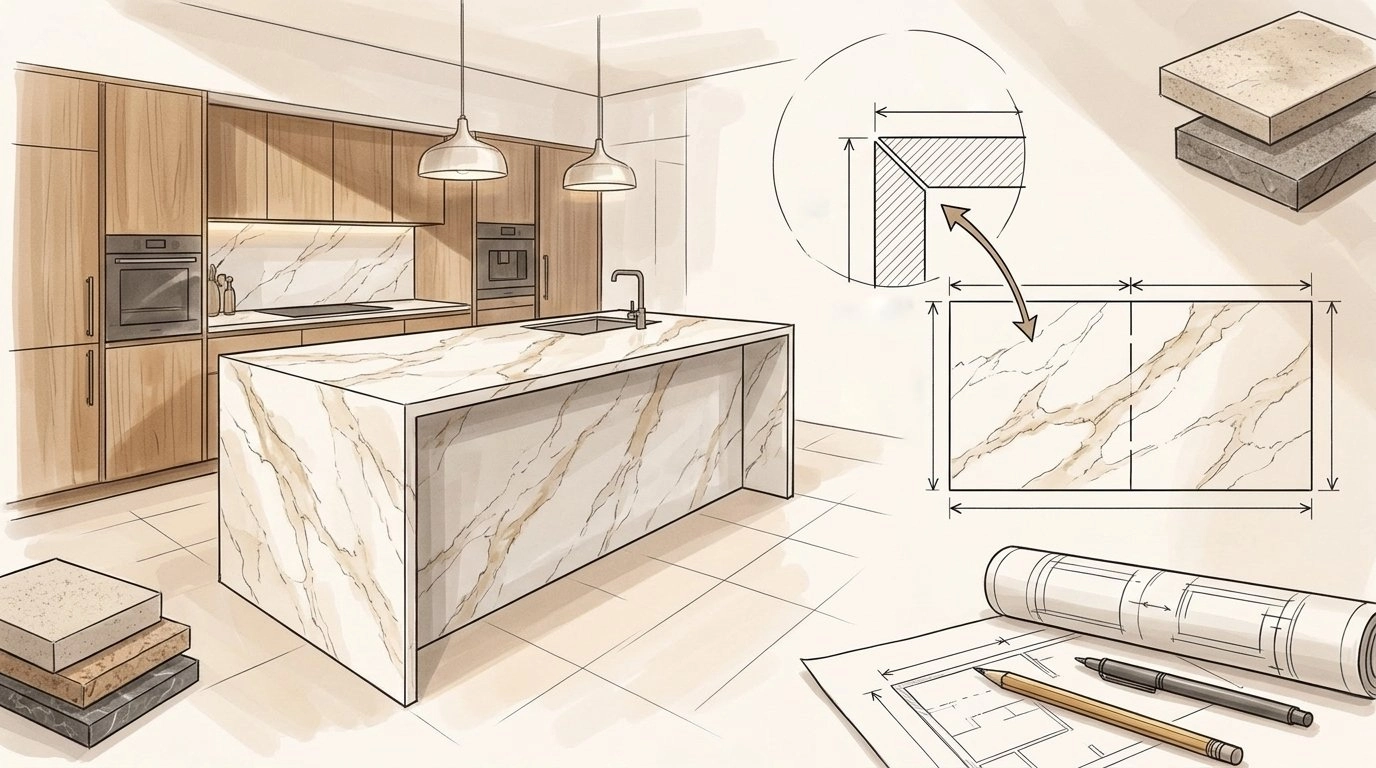
Vein Continuity and Slab Layout
The biggest visual risk in a waterfall countertop edge is having the surface veining break abruptly at the corner. To prevent this, the horizontal surface and vertical panel should be cut from the same slab—or from matching sections of slabs—and their placement should be mapped out on the slab before any cuts are made. With veined designs, this layout directly determines how naturally the pattern flows over the corner. On solid-color surfaces, this risk is much lower.
Seam Line
The vertical panel can function as both an aesthetic feature and a load-bearing element. For this reason, total weight, under-cabinet support, and delivery access along the installation path should all be calculated in advance.
Why Does Full-Body Structure Make a Difference at the Edge?
Edges reveal the internal composition of a surface along its cross-section. When the pattern runs not only across the top surface but throughout the full thickness of the slab, edges and corners maintain a cohesive look that matches the face. You can learn more in our dedicated article on why full-body surfaces make this quality especially valuable in edge and waterfall applications.
Choosing an Edge Profile by Usage Scenario
The right edge is not the one that looks best in theory—it is the one that fits how you actually use the space. The scenarios below help make the decision concrete.
Family Kitchens with Children and Heavy Daily Use
Quarter-round or bullnose profiles with softened corners offer clear advantages in both safety and durability for busy family kitchens. When an edge takes a knock, dispersing the impact across a curve causes far less damage than hitting a sharp corner. For a broader look at surface durability, you can read our guide on quartz countertop scratch, stain, and heat resistance.
Kitchen Islands and Bar Counters
Island and bar edges experience the most frequent elbow and body contact. On the seating side, comfort calls for a softened profile that reduces friction. Points where bar stools or chairs may bump against the edge should also be taken into account. Choosing a gently softened edge instead of sharp lines on this side ensures far more comfortable use over the long term.
Commercial and Hygiene-Focused Spaces
In food preparation areas, clinics, and similar environments, easy wipe-down cleaning is the top priority. Simple, rounded edges with minimal recesses streamline sanitation, whereas multi-stepped decorative profiles add maintenance overhead. In commercial projects, edge selection should always be evaluated alongside usage intensity and cleaning protocols.
Harmony with Cabinet Fronts and Overall Design
The character of the edge should echo the lines of your cabinetry. Clean, understated edges pair best with flat-panel modern cabinets, while more defined profiles create a cohesive look with framed and classic cabinet doors. Considering color and pattern alongside our choosing quartz countertop colors for your kitchen guide makes it easier to see how harmoniously the edge will work with the surface.
Step-by-Step Checklist for Your Edge Decision
1. Define your usage scenario: family kitchen, island, bar, or commercial space.
2. Clarify your cabinet front style and overall design direction.
3. Decide on both the slab thickness and the desired visual edge thickness.
4. Specify the bevel dimension and underside edge finishing.
5. If a waterfall edge is planned, verify the slab layout, vein matching, and delivery path.
6. Confirm the edge specification in writing before approving the template.
Clarifying at the outset with your authorized dealer or fabrication shop which edge finishes can be executed on your chosen surface prevents unexpected surprises later on.
The Right Edge Completes the Right Countertop
Countertop edge profiles shape the final outcome of a project just as much as the surface and color. Define your usage scenario, consider bevel and thickness details together, verify the slab layout early for specialized applications like waterfall edges, and test your choice hands-on with a physical sample.
If you would like to evaluate which surface and edge finish best suit your project, you can contact authorized Coante dealers to inspect samples up close and finalize every fabrication detail before production begins.